What Is a Montessori School? A Morning in the Classroom, Explained
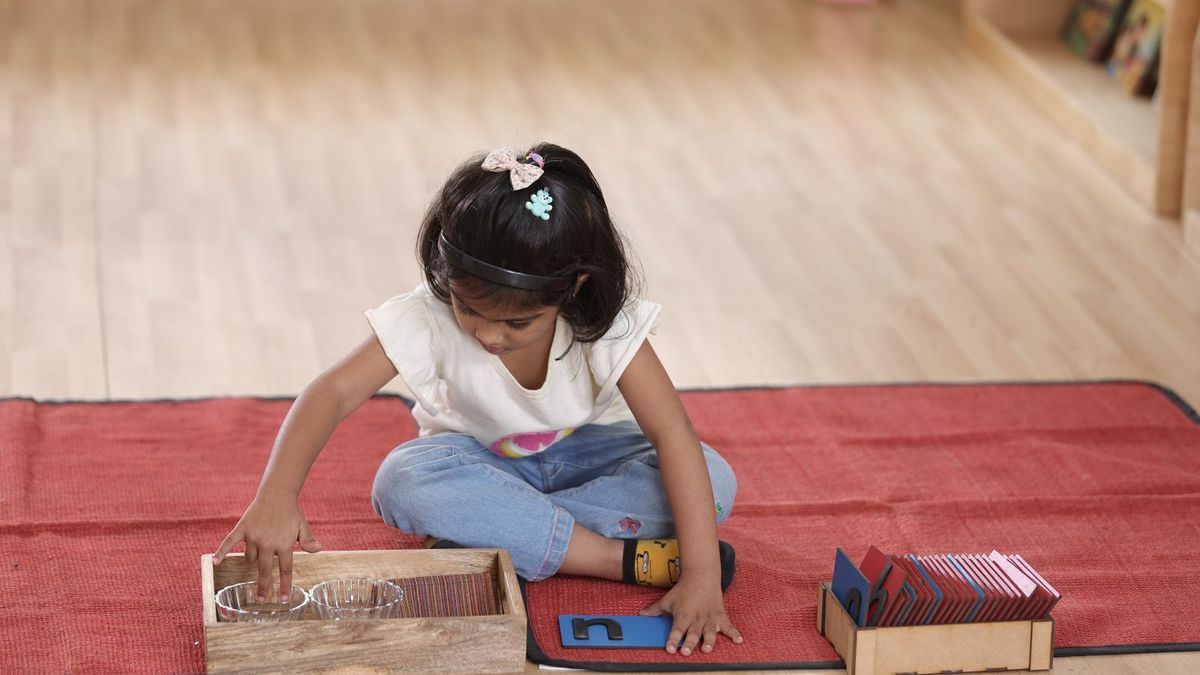
A Montessori school teaches with the method Maria Montessori started in Rome in 1907, when she opened her first Casa dei Bambini, or Children’s House (AMS). Children of three different ages share one classroom, choose their own work from open shelves of hands-on materials, and keep at it for a long, uninterrupted stretch each morning while a trained teacher, often called a guide, gives short lessons to one child or a few at a time. The name isn’t trademarked, so any school can use it, and you have to check how closely a campus follows this model (AMI/USA).
What Does a Montessori Morning Look Like?
The morning below is an illustration. Nora is an invented 4-year-old in a class for ages 3 to 6, and her morning is built from AMI’s classroom standards and AMS’s description of the work period. Times vary by school.
- 8:15 a.m. Nora hangs her coat on a low hook, changes into slippers and says good morning to the guide, who crouches to greet her at eye level. Nobody tells her what to do next.
- Around 8:30, she takes a tray from the practical life shelf and pours water between two small jugs. She spills, wipes up and pours again, four or five times. AMS calls this the work cycle, in which a child chooses an activity, repeats it as often as she likes, then cleans up and puts it back (AMS).
- At 9:05 the guide invites her to a rug for a five-minute lesson with sandpaper letters. She traces s and m with two fingers and says their sounds. The rest of the class keeps working.
- Next to her, a 6-year-old in his third year lays out golden beads to add two four-digit numbers. Nora watches him for ten minutes. Watching counts here, and she does a lot of it.
- Snack sits on a small table. She serves herself when she’s hungry, so the class never stops all at once.
- She spends 45 minutes on a puzzle map of North America, then asks an older girl to read her the labels.
- At 11:30 the work period ends. Children put materials away, gather for a song and go outside before lunch.
That is a three-hour block, the length AMI requires for ages 3 to 6 on five mornings a week (AMI/USA standards). Nora picked four pieces of work, got one lesson and spent her longest stretch on the thing that held her attention.
Why Are Children of Different Ages in One Class?
AMS lists the multi-age classroom as one of its five core components and says three-year age spans “facilitate mentorship among the students and encourage leadership development” (AMS).
A child usually stays three years in the same room. In the first year she mostly watches, the way Nora watched the golden beads. By the third year she is the one helping, and in a 3 to 6 class that third year is the kindergarten year.
Plan for that year before you enroll. In a 2025 national study of 24 public Montessori schools that admit by lottery, children who won a seat pulled ahead only by the end of kindergarten, in reading, short-term memory, executive function and understanding what others think (Lillard et al., 2025).
What Does the Guide Do All Morning?
The AMS glossary describes the job as guiding “each child to purposeful activity based on observations of readiness and interests” (AMS). In plain terms, the guide watches, keeps notes and decides who is ready for which lesson next, rather than teaching the whole class from the front of the room.
AMI standards call for one teacher per class who holds an AMI diploma for that age level, plus one non-teaching assistant in primary and elementary, with an advisory class size of 24 to 35 children (AMI/USA standards).
Ask the School. Which age level did my child’s guide train for? Training is specific to an age level.
AMI vs AMS compares the two main routes.
What Are the Montessori Materials For?
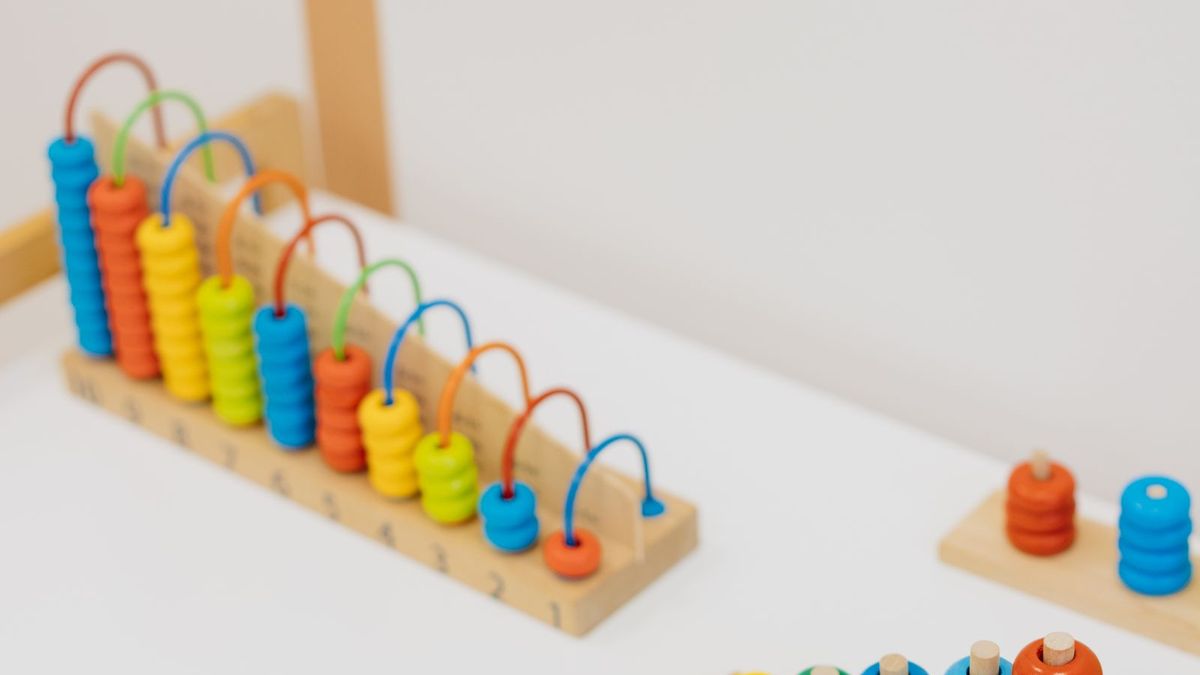
AMS calls specially designed materials “a hallmark of Montessori” (AMS), and its glossary notes that Maria Montessori invented many of them. The pink tower is ten cubes that differ only in size. Golden beads let a child hold a unit, a bar of ten, a square of a hundred and a cube of a thousand.
The materials sit on low, open shelves grouped by area, such as practical life, sensorial, language and math. Our materials guide shows what belongs in each area.
Why Is the Work Period So Long?
A big addition with golden beads doesn’t fit in a 20-minute slot. AMI asks for three hours on five mornings a week in primary and elementary, and two hours each morning for toddlers (AMI/USA standards).
Tip. Ask a school for its daily schedule. If circle time, specials and transitions cut the morning into short pieces, the work period is shorter than these standards describe.
Our page on a day in a Montessori school walks through a full day.
Which Montessori Program Fits My Child’s Age?
Good to Know. Ages shift a little by school, and some primary classes start at 2.5.
| Program | Typical ages | What the day centers on |
|---|---|---|
| Infant | Birth to about 18 months | Movement, feeding, sleep and early language |
| Toddler | About 18 months to 3 years | Self-care, words and doing things alone |
| Primary | 3 to 6 years | Practical life, sensorial work, early reading and math |
| Lower Elementary | 6 to 9 years | Research, group work and the four operations |
| Upper Elementary | 9 to 12 years | Longer projects and more abstract math |
| Adolescent | 12 to 18 years | Land work, small business projects and integrated studies |
Few schools cover the whole range. As of November 2026, about 3,300 of the US schools in our directory list a preschool program and about 1,500 list elementary. In our US directory, open a city and use the Program filter to see which local schools go past age 6. Entry ages are covered in what age to start Montessori, and the teenage years in are there Montessori high schools.
Is Montessori Right for My Child?
Freedom to choose cuts both ways. A child who loves maps can go deep, and a child who avoids math can avoid it for a while unless the guide notices and steps in. Ask what the guide does when a child skips an area for weeks, and how they help a child who waits to be told what to do.
The other trade-offs are practical.
- Most US Montessori schools are private and charge tuition. See what Montessori school costs and public, tuition-free options.
- Progress reports may look nothing like a report card. Ask for an anonymized example, and see do Montessori schools give grades.
- Leaving after one or two years of a three-year cycle means missing the year it is designed to finish with.
- Quality varies because anyone can use the name. Our guides on accreditation and how to choose a school show what to check.
The best test is to watch a class for half an hour during the morning work period. Bring our tour checklist, and start by finding Montessori schools near you.
Find Montessori Schools Near You
Search by city, zip code or school name, or browse every country.
Browse All LocationsRelated Guides

How Much Does Montessori School Cost Once You Add Fees and Aftercare?
Build a real Montessori budget from tuition, fees, meals, aftercare and closed weeks, with dated national figures, tax help and questions for the school.
6 min read
How to Choose a Montessori School Before You Book a Tour
Narrow a Montessori shortlist before touring, using your child's age at entry, an ordinary weekday school run, your top priorities and what listings show.
5 min read
Are Montessori Schools Public or Private? How to Find Tuition-Free Options
Most US Montessori schools are private, but hundreds are public and free. See the latest counts, how lotteries work and how to find a program near you.
5 min read