How Do Montessori Schools Teach Reading, and How Will I Know My Child Is Progressing?
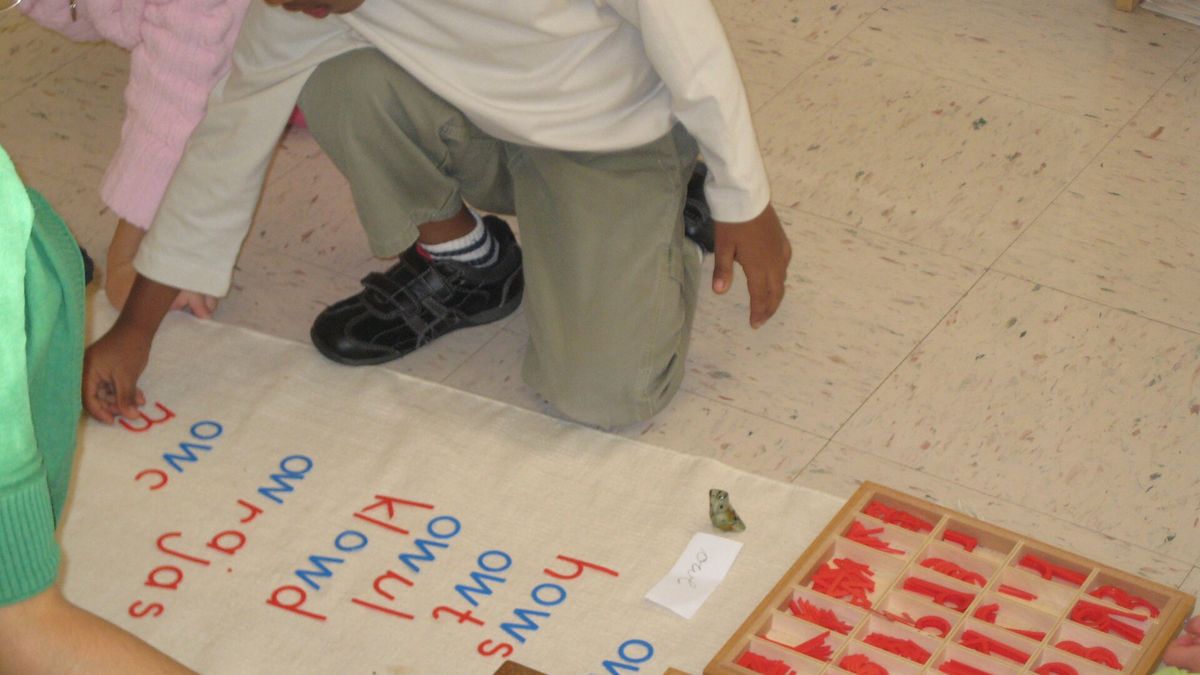
Montessori classes teach reading through sounds. Children first learn to hear the separate sounds in spoken words, then trace sandpaper letters while saying each letter’s sound, then build words of their own with a box of loose letters, and reading grows out of sounding those words back. To see how your child is doing, ask for dated samples of their work and the teacher’s record of which lessons they have had and what they can now do alone.
What Comes Before the First Letter?
Listening comes first. AMI describes the usual Montessori approach as one in which the child “explores the sounds of his/her own language, isolating sounds they hear” before any letters appear (AMI, Phonetic Approach to Language). In a classroom that might sound like a teacher asking a 3-year-old to find something on the shelf that starts with mmm, then something that ends with t.
AMI’s list of language work for ages 3 to 6 also puts spoken language ahead of writing and reading (AMI, Montessori 3 to 6).
How Do Sandpaper Letters Work?
Each letter is cut from fine sandpaper and glued to a smooth card. Maria Montessori described the lesson in The Montessori Method, the 1912 English edition of her first book (Project Gutenberg). The teacher says the letter’s sound, not its name, and guides the child’s finger over the letter in the direction it is written. If the finger slips off, the smooth card tells the child at once.
The aim is to tie the sound, the shape and the hand movement together. AMI describes letters that are “traced (preparing for writing), seen and the sound is heard.”
Why Do Children Build Words Before They Read Them?
Once a child knows about half of the sandpaper letters, AMI says, the teacher brings out the moveable alphabet, “a box of moveable letters with which the child can ‘write’ words in her own vocabulary,” before her hand can control a pencil. A child says a word slowly, picks the letter for each sound and lays it on a mat. With enough of this, AMI writes, children “begin to fuse the sounds into words and read them back.”
Montessori put the order bluntly in 1912. “Contrary to the usually accepted idea, writing precedes reading,” she wrote, and she meant something specific by reading. A child sounding out a word she has just built already knows the word. Reading, for Montessori, was understanding a word or sentence someone else wrote. AMS keeps the same order today and calls writing “a precursor to reading” (AMS, Early Childhood).
In languages with irregular spelling, English among them, AMI says the harder parts, such as the sounds made by letter combinations, come once a child reads phonetic words easily. Expect early spellings such as “fon” for phone.
Good to Know. Building a word is a step before reading it. Montessori noted in 1912 that in most cases a child who wrote beautifully still read “rather poorly” at first, so ask whether your child reads words they didn’t build.
What Does the Research Say About Montessori and Reading?
The strongest studies compare children who won or lost a lottery for a Montessori place, or who were assigned at random.
In the 2025 national study of 24 public Montessori schools, children offered a seat at age 3 scored higher on an early reading test at the end of kindergarten, with an effect size of about 0.30 (Lillard et al., PNAS, 2025). In percentile terms, the authors estimate that a median reader from a traditional program would have scored around the 62nd percentile. There was no reading difference after the first two preschool years, and vocabulary scores did not differ significantly. The authors suggest Montessori’s start with writing and its emphasis on phonics may explain the result, an idea the study did not test.
A French study randomly assigned children in one disadvantaged public preschool near Lyon to Montessori or conventional classes. The Montessori classes used fewer materials, shorter work periods and teachers with limited Montessori training, and their kindergartners still outperformed peers in reading, with an effect size of 0.68 (Courtier et al., Child Development, 2021). Five years later, after all the children had spent elementary school in conventional classes, the reading difference was gone among the 97 who were tested again, though a new advantage in math problem-solving had appeared (Le Diagon et al., Scientific Reports, December 2025).
An older Milwaukee lottery study also found an early lead. Montessori 5-year-olds scored higher on letter-word identification and on sounding out unfamiliar words, while 12-year-olds did no better on those tests, though their essays were more creative and their spelling and grammar similar (Lillard and Else-Quest, Science, 2006).
Across 32 studies, a 2023 review put the average Montessori advantage in language at 0.17, rated high-quality evidence. The authors also estimate that missing studies could account for about a tenth of a standard deviation in the language and literacy results (Randolph et al., Campbell Systematic Reviews, 2023). Our guide on whether Montessori is worth it covers the wider evidence.
How Will I Know My Child Is Progressing?
Grades won’t tell you, because many Montessori schools don’t give them at this age. The evidence you want is the child’s own work, dated, plus the teacher’s notes on what comes next. Ask for these at each conference.
- Dated samples of words or sentences my child built or wrote, a few months apart
- The letter sounds my child knows, and which ones the teacher plans to present next
- Whether my child reads words they didn’t build, such as a label or a short book
- How the teacher decides the next reading lesson
- Which reading test, if any, the school uses, and in which grades
- What the teacher does if my child avoids language work for weeks
Photos of moveable alphabet work count as samples, since a child often builds words long before writing them by hand. For the reports themselves, see whether Montessori schools give grades.
Ask the School. How do you decide which reading lesson my child gets next, and when would you tell me if you were worried?
What If My Child Isn’t Reading Yet?
AMI says many children read before 6 and that the approach changes for elementary children who are not yet reading. Ages vary widely, and Montessori wrote in 1912 that her classes did not force or even invite children into these lessons.
A slow start can still need attention. Ask the school who screens for reading difficulties, at what age, and what help it can offer, then compare the answer with what your public school district provides. If your child will move to a conventional first grade, ask that school what it expects new first graders to read. Our guide to choosing a Montessori elementary school covers how teachers bring in children at 6 and later.
To compare how nearby schools report reading progress, shortlist two or three from your city page in find Montessori schools near you and send each the questions above.
Find Montessori Schools Near You
Search by city, zip code or school name, or browse every country.
Browse All LocationsRelated Guides
What Is a Montessori School? A Morning in the Classroom, Explained
What a Montessori school is, told through one illustrative morning, with mixed ages, the guide, the materials, programs by age and honest trade-offs.
6 min read

How Much Does Montessori School Cost Once You Add Fees and Aftercare?
Build a real Montessori budget from tuition, fees, meals, aftercare and closed weeks, with dated national figures, tax help and questions for the school.
6 min read

How to Choose a Montessori School Before You Book a Tour
Narrow a Montessori shortlist before touring, using your child's age at entry, an ordinary weekday school run, your top priorities and what listings show.
5 min read