Is Montessori School Worth It for Your Child? Benefits and Trade-Offs to Weigh

It can be, though the research points to a modest average gain that no study can promise for your own child. The most careful studies find Montessori children somewhat ahead in reading, math and self-control, mostly in preschool and elementary, and a few solid studies find no difference at all. For your family, it comes down to the quality of the school in front of you and its cost in tuition, driving and the move to the next school.
What Does the Research Say on Average?
The broadest summary is a 2023 Campbell systematic review of 32 studies, published through February 2020, in which the Montessori and comparison groups started out alike through random assignment or statistical adjustment (Randolph et al., 2023).
Montessori students came out ahead by about a quarter of a standard deviation on academic outcomes (an effect size of 0.24) and by 0.33 on nonacademic ones such as executive function and creativity. The authors call that small next to laboratory studies but medium-large to large for real schools. Effects were bigger in randomized studies, in preschool and elementary than in middle or high school, and in private than in public Montessori schools.
The review flags its own weak spots. Small studies favoring conventional schooling seemed to be missing, a possible sign of publication bias, and when the authors filled that gap statistically, the academic average fell to about 0.14, still in Montessori’s favor. Several authors disclose ties to Montessori schools or training, among them Angeline Lillard, who also led the 2025 trial below.
What Did the 2025 National Lottery Study Find?
This study followed 588 children who entered admission lotteries at age 3 for 24 oversubscribed public Montessori schools across the US, comparing the 242 offered a seat with the 346 who were not (Lillard et al., PNAS, October 2025). Testing ran from fall 2021 to the end of kindergarten in 2024.
After the first two preschool years there were no notable differences. By the end of kindergarten, children offered a seat scored higher in early reading, short-term memory, executive function and theory of mind, with effect sizes from 0.22 to 0.30. In the authors’ terms, a child at the median in a traditional program would have read at about the 62nd percentile with a Montessori seat. Math and vocabulary differences were not statistically significant.
Read the limits too. Only about one lottery family in five agreed to take part, kindergarten scores were missing for 32% of the Montessori group and 42% of the others, and roughly half the children offered a seat were still in Montessori by kindergarten. The authors write that their results may not apply to all public Montessori schools.
The study also priced the three years. Public Montessori from age 3 through kindergarten cost districts an estimated $13,127 less per child than traditional programs, mostly because Montessori classes for 3- and 4-year-olds had more children per teacher. That is the school system’s cost, not your tuition.
Did Any Studies Find No Difference?
Yes. Some found mixed results, and a few found no gain.
- In a 2006 lottery study at one AMI-recognized public school in Milwaukee, Montessori 5-year-olds scored higher on reading and math tests, but 12-year-olds did no better on the same tests, though their essays were rated more creative. Groups were small, 30 and 25 children at age 5 (Lillard and Else-Quest, Science, 2006).
- In Miami public pre-K for low-income 4-year-olds, Latino children gained the most in Montessori classes, while Black children gained slightly more in conventional ones. Children were not assigned at random, and the Montessori classes held only 4-year-olds (Ansari and Winsler, 2014).
- At Dutch Montessori secondary schools that admit by lottery, students earned their diploma on time at the same rate as others, with similar grades and no edge on measures of independence, among 308 to 625 students depending on the outcome (Ruijs, 2017).
- French children whose public Montessori preschool classes had given them a reading lead in kindergarten no longer read better than their peers in fifth grade, after five years in conventional classes, though a math advantage had appeared (Le Diagon et al., Scientific Reports, December 2025).
Gains show most clearly in the early years, while children are still in a Montessori class, and quality varies because anyone can use the name. Our page on Montessori research summarizes more studies.
Good to Know. These are group averages. A modest average gain can include many children who did no better than their peers, and some who did far better.
What Will It Cost Your Family?
Most US Montessori schools are private and set their own tuition, so the price that counts is the fee sheet for the year your child would start. Add fees, lunches, before and after care, and the weeks the school is closed. Our guide to Montessori school costs builds a full-year budget.
Public Montessori programs charge no tuition, but seats often go by lottery, so see our guides to tuition-free Montessori options and public Montessori lotteries.
Can You Manage the Drive Twice a Day for Three Years?
A school that fits on paper can still fail on an ordinary weekday. Drive the route at drop-off time with any younger siblings in the car, and again at pickup, then check when class ends against when you can collect your child. Montessori classes run in three-year cycles, so you are signing up for that drive for years.
Our guides on Montessori for working parents and how to choose a school cover hours and shortlisting.
Will It Suit Your Child?
Montessori gives children a lot of choice during a long work period. A child who loves maps can spend weeks on them. A child who waits to be told what to do, or avoids math, needs a teacher who notices and steps in, so ask how the guide helps a child start work and what happens when one subject goes untouched for weeks.
What Happens After the Last Montessori Year?
Plan the exit before the entrance. Many Montessori schools stop at age 6, and in our US listings, schools with a preschool program outnumber those listing elementary by more than two to one (November 2026). If your child will move to a conventional school, ask the district how it would place them and when to apply. The French follow-up suggests an early reading lead can shrink once children move on, so weigh the years you can realistically stay.
Ask the School. Where did last year’s oldest children go next, and how many of the children who started at 3 stayed through the kindergarten year?
A Fit Checklist Before You Commit
- I have watched a class for half an hour during the morning work period.
- I have the full-year cost in writing, including fees, care and closed weeks.
- We have driven the route at drop-off and pickup, and class hours plus paid care cover our workdays.
- The guide explained how they help a child who doesn’t choose any work.
- I know the lead teacher’s training for this age level and have checked the school’s accreditation.
- We know the next school after the program’s last year, and its application dates.
- We can afford to stay to the end of the three-year cycle.
Open your city from find Montessori schools near you and set the Program filter to Elementary to see which local schools continue past age 6.
Find Montessori Schools Near You
Search by city, zip code or school name, or browse every country.
Browse All LocationsRelated Guides
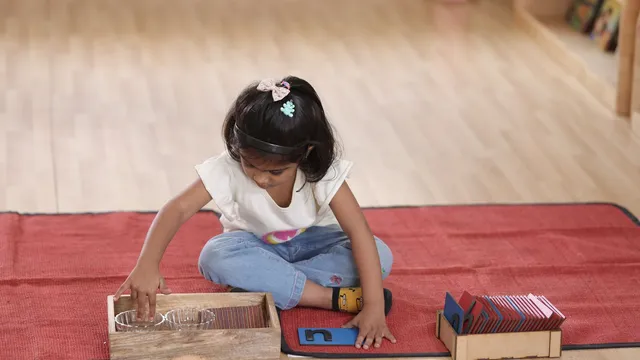
What Is a Montessori School? A Morning in the Classroom, Explained
What a Montessori school is, told through one illustrative morning, with mixed ages, the guide, the materials, programs by age and honest trade-offs.
6 min read

How Much Does Montessori School Cost Once You Add Fees and Aftercare?
Build a real Montessori budget from tuition, fees, meals, aftercare and closed weeks, with dated national figures, tax help and questions for the school.
6 min read

How to Choose a Montessori School Before You Book a Tour
Narrow a Montessori shortlist before touring, using your child's age at entry, an ordinary weekday school run, your top priorities and what listings show.
5 min read